Home › Plant guides › Trees & shrubs for containers
Home › Gardening in containers › Trees & shrubs for containers
Choosing Plants For Container Gardening
Trees And Shrubs
When choosing plants for container gardening, mix trees and shrubs with flowering and other plants to add real impact to your display. Use them as focal points and to add drama.
The most successful container gardens employ this technique, using trees and shrubs to add height and structure and to create a sense of permanence.
The following list of suggestions for suitable trees and shrubs for your container garden is not meant to be exhaustive but includes some of my favourites. I hope it gives you some ideas for your own container garden.
More ideas for suitable plants for your container garden can be found at Choosing Plants for Container Gardening: Bamboos, Grasses, Ferns and Spiky Plants.
Choosing Plants for Container Gardening: Trees
Many trees are very well suited to container growing and can be used to form stunning focal points in the garden. Their size and scale gives an opulent and luxurious feel and adds drama, height and structure to your display.
As the roots are confined, trees that would normally reach a considerable size are effectively dwarfed, and the figures for height and spread given below reflect this.
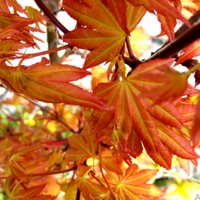
Acer palmatum (Japanese Maple)
- Form:
- small tree
- Foliage:
- deciduous
- Hardiness:
- UK - fully hardy; USDA zones 6 to 8
- Situation:
- prefers partial shade
- Height:
- 1-1.5m (3-4.5ft)
- Spread:
- 1-2m (3-6.5ft)
- Awards:
- RHS AGM
Reasons to grow: Essential for a Japanese style garden (or indeed for any garden) these deciduous trees have delicately cut leaves and spectacular autumn colour.
Many different varieties are available giving you a choice of leaf shape and colour. Some also have attractively coloured bark. The one in the photo is one of our favourites A. palmatum 'Sango Kaku', the Japanese Coral Bark Maple.
Although they are fully hardy, you should position the container in a sheltered position to avoid wind scorch on the leaves.
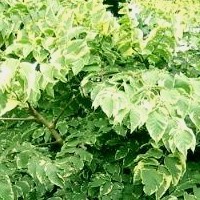
Aralia elata (Japanese Angelica Tree)
- Form:
- small tree
- Foliage:
- deciduous
- Hardiness:
- UK - fully hardy; USDA zones 4 to 9
- Situation:
- partial to deep shade
- Height:
- 3m (10ft)
- Spread:
- 2m (6.5ft)
- Awards:
- RHS AGM
Reasons to grow: A really striking deciduous tree with good architectural form. The divided leaves are edged in cream and form elegant tiers. Clusters of small white flowers appear in late summer and autumn, followed by black fruits.
It is fully hardy and I find it very useful for a shady spot.
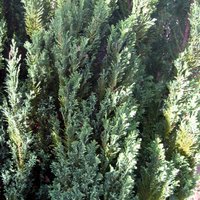
Chamaecyparis lawsoniana 'Chilworth Silver' (Lawson Cypress)
- Form:
- dwarf conifer
- Foliage:
- evergreen
- Hardiness:
- UK - fully hardy; USDA zones 5 to 9
- Situation:
- sun to partial shade
- Height:
- up to 2m (6.5ft)
- Spread:
- up to 90cm (3ft)
- Awards:
- RHS AGM
Reasons to grow: Many varieties of this attractive evergreen conifer are available but the compact, upright 'Chilworth Silver' is ideal for containers. The neat shape and dense aromatic foliage make a strong architectural statement and the silvery blue foliage combines well with golden leaved plants.
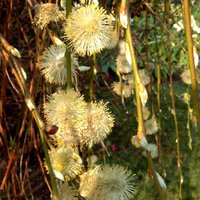
Salix caprea 'Kilmarnock' (Kilmarnock Willow)
- Form:
- small tree
- Foliage:
- deciduous
- Hardiness:
- UK - fully hardy; USDA zones 4 to 9
- Situation:
- sun
- Height:
- 1.5-2m (4.5-6.5ft)
- Spread:
- up to 2m (6.5ft)
- Awards:
- RHS AGM
Reasons to grow: Deciduous tree with a weeping habit that looks good all year round. In winter the weeping branches add structure and interest to the garden, and in spring they are covered in delightful furry catkins. Once the leaves develop the whole tree forms an architectural leafy dome.
It looks good planted in a large container with small early flowering bulbs around the base of the trunk.
Choosing Plants for Container Gardening: Shrubs
Many shrubs are also suitable for growing in containers, and are useful for adding structure and for softening the appearance of walls and fences. To add sculptural form look for evergreen shrubs with boldly shaped foliage.
Buxus sempervirens (Common Box)
- Form:
- shrub
- Foliage:
- evergreen
- Hardiness:
- UK - fully hardy; USDA zones 6 to 8
- Situation:
- sun to partial shade
- Height:
- up to 2m (6.5ft)
- Spread:
- up to 90cm (3ft)
- Awards:
- RHS AGM
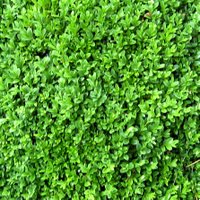
Reasons to grow: This one needs no introduction as it is a very well known container shrub! In fact, where would we be without it?
Evergreen, with densely packed small leaves, it is ideal for clipping into geometric shapes such as balls, cones and spirals. (If you want to try your hand at topiary you can buy wire frames in a wide variety of shapes including animals and birds.)
Use as a focal point or use a matching pair of box cones or spirals to frame an entrance or doorway.
Camellia japonica (Camellia)
- Form:
- flowering shrub
- Foliage:
- evergreen
- Hardiness:
- UK - fully hardy; USDA zones 7 to 9
- Situation:
- partial shade
- Height:
- 2m (6.5ft)
- Spread:
- 1m (3ft)
- Awards:
- RHS AGM
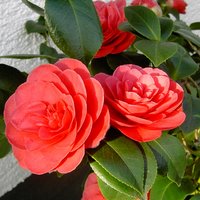
Reasons to grow: If you have alkaline soil this is your chance to grow this beautiful evergreen shrub with its glossy leaves and glorious flowers in shades of white, pink and red. Both double and single flowered varieties are readily available.
If you choose one of the early flowering types, be sure to position the container in a sheltered spot to prevent frost browning of the blooms. Plant in ericaceous compost.
xFatshedera lizei (Tree Ivy)
- Form:
- shrub
- Foliage:
- evergreen
- Hardiness:
- UK - frost hardy; USDA zones 8 to 11
- Situation:
- partial to full shade
- Height:
- up to 2m (6.5ft)
- Spread:
- up to 1m (3ft)
- Awards:
- RHS AGM
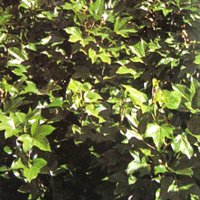
Reasons to grow: A really useful evergreen shrub that can be trained up a vertical support. It has large glossy lobed leaves and rounded clusters of greenish white flowers in autumn. It is a good choice for urban gardens as it is tolerant of pollution and shade.
The plant has an interesting and unusual background as it is a actually a cross between Fatsia japonica (see below) and the Irish Ivy Hedera helix var hibernica.
Fatsia japonica (Japanese Aralia)
- Form:
- shrub
- Foliage:
- evergreen
- Hardiness:
- UK - frost hardy; USDA zones 8 to 10
- Situation:
- sun or shade
- Height:
- 1.5m (4.5ft)
- Spread:
- 1m (3ft)
- Awards:
- RHS AGM
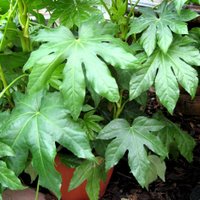
Reasons to grow: A really good architectural foliage plant for container gardening with large, glossy, lobed leaves. In autumn whitish flowers appear in upright rounded clusters, followed by black berries. It has a spreading form and prefers a shaded sheltered position.
It tolerates atmospheric pollution and is the perfect choice for a shady urban garden. It is also suitable for creating a tropical effect.
Hydrangea macrophylla (Hydrangea)
- Form:
- shrub
- Foliage:
- deciduous
- Hardiness:
- UK - hardy; USDA zones 6 to 9
- Situation:
- sun or partial shade
- Height:
- 1m (3ft)
- Spread:
- 1.5m (4.5ft)
- Awards:
- many hold the RHS AGM
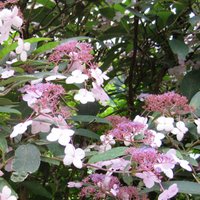
Reasons to grow: Hydrangeas are often considered rather old fashioned but there are signs that they are regaining some of their former popularity, and rightly so as they look superb in large wooden planters or half barrels.
The coloured varieties only produce blue flowers in acidic soil so container growing is ideal if you live in a limestone area and want blue blooms. Although they are deciduous, the flowers dry out and are retained on the branches providing winter interest.
Choose from lacecap or mophead varieties: the lacecaps have flattish spreading flowerheads whilst the mopheads, as the name suggests, have rounded flowerheads.
Laurus nobilis (Bay Tree, Bay Laurel, Sweet Bay)
- Form:
- shrub or small tree
- Foliage:
- evergreen
- Hardiness:
- UK - frost hardy; USDA zones 8 to 10
- Situation:
- prefers partial shade
- Height:
- 2-3m (6.5-10ft)
- Spread:
- 1-2m (3-6.5ft)
- Awards:
- RHS AGM
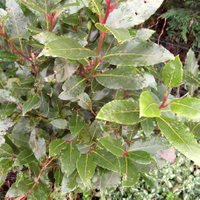
Reasons to grow: This is another deservedly well known shrub or small tree for containers. The handsome evergreen foliage can be clipped into shape giving form and structure, and it looks particularly good grown as a standard in a formal setting.
It is only frost hardy so position it in the warmth of a sunny wall. If, like us, you regularly use the leaves to flavour your cooking, plant it in a handy location near your kitchen door.
Myrtus communis (Common Myrtle)
- Form:
- shrub or small tree
- Foliage:
- evergreen
- Hardiness:
- UK - frost hardy; USDA zones 8 to 10
- Situation:
- sun to light shade
- Height:
- 1m (3ft)
- Spread:
- 1m (3ft)
- Awards:
- RHS AGM
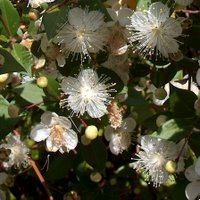
Reasons to grow: Make the most of this delightful aromatic shrub by positioning it close to a sitting area. It has a dense rounded shape and in late summer the fragrant white flowers stand out against the evergreen foliage.
It needs to be placed away from cold winds in the winter and, depending on where you live, may need extra protection during the coldest periods.
Need More Information?
If you would like more ideas on what to plant, go to Choosing Plants for Container Gardening: Bamboos, Grasses, Ferns and Spiky Plants.
Not sure what type of containers to buy? Check out the different types and materials at garden plant container.
General tips and information about container gardening can be found at gardening in containers.
Not looking for container plants? Head over to plant guides for links to all the 'plants for places' pages on this site.
Home › Plant guides › Trees & shrubs for containers
Home › Gardening in containers › Trees & shrubs for containers

Recent Articles


-
Best Climbers For Sandy Soil
Feb 27, 14 07:52 AM
Climbers for sandy soil need to be able to cope with free draining conditions and relatively low soil fertility. These are my favourite climbers for sand. -
Best Perennials For Sandy Soil
Feb 26, 14 05:51 AM
The best perennials for sandy soil positively thrive in free draining soils with low fertility. These are my favourite perennials for growing in sandy soil. -
How To Use A Soil pH Test Kit
Jan 08, 14 08:19 AM
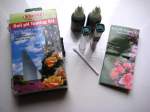 How to use a soil pH test kit to find out if your garden soil is acid, alkaline or neutral. Soil pH kits are cheap, effective, simple to use, and are an indispensable aid to more successful gardening.